
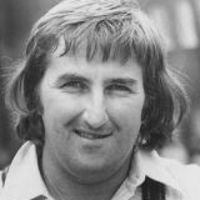
Gary Gilmour

- Mark Chapman
- Devon Conway
- Tom Latham
- Daryl Mitchell
- Glenn Phillips
- Rachin Ravindra
- Mitchell Santner
- Ish Sodhi
- Tim Southee
- Will Young
Alphabetically sorted top ten of players who have played the most matches across formats in the last 12 months
Full Name
Gary John Gilmour
Born
June 26, 1951, Waratah, New South Wales
Died
June 10, 2014, RPA Hospital, Sydney, (aged 62y 349d)
Batting Style
Left hand Bat
Bowling Style
Left arm Fast medium
At his mid-1970s peak, Gary Gilmour was a penetrative left-arm swing bowler and a talented hitter, bringing comparisons with another left-armer from New South Wales's central coast, Alan Davidson. He struck 122 on his first outing for New South Wales in January 1972, and made 52 and took 4 for 75 on his Test debut against New Zealand two years later. He then excelled in English conditions when Australia toured England in 1975; his 6 for 14 in the World Cup semi-final against England and 5 for 48 in the final against West Indies were followed by 9 for 157 in the third Test at Headingley. But after an impressive home series against West Indies, Gilmour's powers as a bowler ebbed dramatically, so much so that he bowled only nine inconsequential overs in the Centenary Test. A debilitating foot injury was a handicap; so was a light-hearted attitude to training and fitness that owed more to the 1950s than to the increasingly professional era of which he was part.
Gideon Haigh
Gary Gilmour Career Stats
Batting & Fielding
| Format | Mat | Inns | NO | Runs | HS | Ave | BF | SR | 100s | 50s | 4s | 6s | Ct | St |
|---|---|---|---|---|---|---|---|---|---|---|---|---|---|---|
| Tests | 15 | 22 | 1 | 483 | 101 | 23.00 | 708 | 68.22 | 1 | 3 | 67 | 6 | 8 | 0 |
| ODIs | 5 | 2 | 1 | 42 | 28* | 42.00 | 39 | 107.69 | 0 | 0 | 7 | 0 | 2 | 0 |
| FC | 75 | 120 | 18 | 3126 | 122 | 30.64 | - | - | 5 | 18 | - | - | 68 | 0 |
| List A | 19 | 14 | 1 | 182 | 44 | 14.00 | - | - | 0 | 0 | - | - | 4 | 0 |
Bowling
| Format | Mat | Inns | Balls | Runs | Wkts | BBI | BBM | Ave | Econ | SR | 4w | 5w | 10w |
|---|---|---|---|---|---|---|---|---|---|---|---|---|---|
| Tests | 15 | 28 | 2661 | 1406 | 54 | 6/85 | 9/157 | 26.03 | 3.17 | 49.2 | 2 | 3 | 0 |
| ODIs | 5 | 5 | 320 | 165 | 16 | 6/14 | 6/14 | 10.31 | 3.09 | 20.0 | 0 | 2 | 0 |
| FC | 75 | - | 13830 | 7345 | 233 | 6/85 | - | 31.52 | 3.18 | 59.3 | - | 6 | 0 |
| List A | 19 | - | 1046 | 648 | 29 | 6/14 | 6/14 | 22.34 | 3.71 | 36.0 | 0 | 2 | 0 |
Records of Gary Gilmour
Explore Statsguru Analysis
Recent Matches of Gary Gilmour
| Match | Bat | Bowl | Date | Ground | Format |
|---|---|---|---|---|---|
| NSW vs South Aust | 24 | 1/44 & 0/5 | 23-Feb-1980 | Sydney | FC |
| NSW vs Victoria | 21 | 1/53 | 25-Nov-1979 | Melbourne | List A |
| NSW vs West Aust | 2 | 2/39 | 21-Nov-1979 | Sydney | List A |
| NSW vs Queensland | -- | 2/28 | 18-Nov-1979 | Brisbane | List A |
| NSW vs Tasmania | 1 | 0/25 | 11-Nov-1979 | Hobart | List A |
Debut/Last Matches of Gary Gilmour
Test Matches
ODI Matches
FC Matches
List A Matches